Change Language :
Maintenance-free plastic rollers
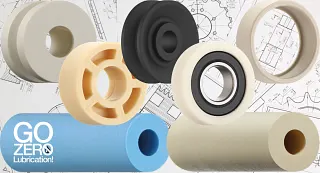
The plastic rollers from igus cover a broad range of industrial applications. The portfolio includes guide rollers, knife edge rollers for conveyor belts, pulleys and track rollers made of plastic, as well as roller adapters (including plastic coatings) for ball bearings.
Whether for mechanical engineering, conveyor technology or plant construction: The rollers are available with different diameters, widths, geometries and materials, from standard to customised versions. The plastic rollers are available in many different types and can be directly integrated into existing designs, supported by CAD models, drawings and technical parameters such as loads, speed and temperature ranges for planning and selection.
Depending on the requirements, they are available as complete rollers with integrated bearings or as roller adapters for assembly on standard hubs - also for drive, deflector and guiding tasks.
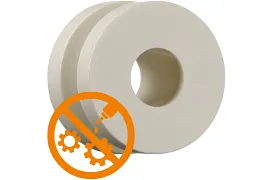


Free rollers sample boxes
You will find the following in our sample box:
✅ Two-component rollers
✅ Profile guide rollers
✅ Knife edge rollers
✅ Track rollers
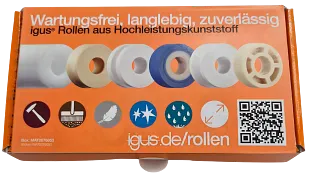
iglidur rollers range at a glance


Special roller parts as required
We manufacture rollers made of plastic in the shape, quantity and material of your choice. Because the right dimensions and materials are not always included in the standard range. There are various manufacturing processes to choose from. Ask our experts for a consultation without obligation now!
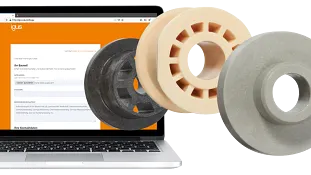
Three customers. Three solutions. Three strong voices.

The belt is partly coated and oiled. As the special plastic is insensitive, there is no wear or damage caused by scratches or other quality losses. The surfaces are in perfect condition.
Günter Keller
Product Manager Special Systems | Kohler Maschinenbau GmbH

Our systems are used around the world, and they do not fail. iglidur knife edge rollers simply work and have hardly any noticeable wear. They are also easy to assemble and save our customers time-consuming maintenance work.
Jürgen Werner
Design Engineer | Krones AG

We initially contacted various plastic suppliers. However, the results were not satisfactory. Either rollers or the rotary axis wore out even more. Only when we brought igus on board did we gradually come closer to solving the problem. [...] We now have no more complaints and the service life has been significantly extended.
Jürgen Steimmer
Group Manager Labelling Technology | Krones AG
To the user reports:
FAQ
Plain bearing as a roller? Is it really that easy?
At first glance, the benefits of plain bearings for use as rollers appear very attractive. They take up significantly less space than ball bearings, are lubrication-free depending on the version and less susceptible to dust and cleaning agents. Bearings made of plastic are corrosion-free and are also generally less expensive and lighter.
A plain bearing is usually installed in such a way that it is firmly pressed into a housing bore. A shaft then rotates in this fixed bearing. We speak of a roller when the plain bearing moves around the rigid shaft, which is then called an axis, as it does not transmit torque. Then it rolls around along the outer diameter. For example, on a guide rail, link roller guide or any other surface.
Rolling instead of sliding. Or rolling and sliding?
A practical example is a sliding door on a cabinet that is mounted on rollers. Rollers are attached to the door, which in turn roll on rails. Viewed in detail, we have small locked axes on which the rollers rotate. Ideally, the rollers rotate about their axes when the door is pushed. The situation is different if the roller does not unroll but stops and slides over the rail instead. The door would become stiff, as the resistance would be higher. After all, the weight of the door rests on the very small contact surface between the roller and the rail.
Here are some helpful tips for designing one-piece plastic rollers:
- Choose the largest possible outer diameter with the smallest possible inner diameter.
- Increase the friction between the outer diameter and the rolling surface.
- Use rollers with roller adapters.
Choosing the right material
While a plain bearing is designed to carry a load applied by the shaft and to generate as little heat as possible with as little friction as possible when moving, the whole thing looks a little different in a roller application. As the bearing does not sit "comfortably" in a housing bore, which in the best case supports half the bearing circumference, only the support point on the roller track is available for a roller. The resulting surface pressure on the outer diameter is high. It doesn't really matter what material the roller is made of. The so-called "Hertzian compression" forces pretty much every material to its knees to varying degrees. The result is a flattening. Reinforcing fibres in the plastic provide a remedy here.
Consulting
I look forward to answering your questions
Hennlich doo Beograd+381 11 63 098 17Write e-mail
Shipping and consultation
In person:
Monday to Friday from 7 am - 8 pm.
Saturdays from 8 am- 12 pm.
Online:
24h
WhatsApp-Service:
Montag – Freitag: 8 – 16 Uhr