Change Language :

Chemical recycling with HydroPRT - igus invests in Mura Technology Limited
New technology recovers resources from plastic waste within 30 minutes
The problem: Eight million tonnes of plastic end up in the world's oceans every year. These lost resources are worth around $80 billion. Up to now, most plastic has been incinerated and only 14% recycled. Around the world, mixed waste is always left over. In the case of non-technical plastics, it is 100 to 1,000 times the amount.
The solution: In 2007, Mura Technology Limited developed a new form of chemical recycling and tested it for over ten years in a pilot plant in Australia - the so-called Hydrothermal Plastic Recycling Solution (HydroPRS). This solution has since been renamed HydroPRT, which stands for Hydrothermal Plastic Recycling Technology.
HydroPRT makes it possible to convert conventionally non-recyclable plastic waste back into oil within 30 minutes. The method is much more resource-efficient than extracting fossil oil, as it saves up to five barrels of oil per ton of plastic waste processed. Only water, high temperatures and pressure are used to separate the cells and join them together again. One plant alone can process 20,000 tons of plastic per year, reducing CO2 output by 28,180 tonnes. That is the annual consumption of 5,983 cars and the annual energy needs of 4,914 households. The plant's capacity, however, is to be tripled in the long term.
Conventional plastic recycling vs. recycling with HydroPRT


igus supports the circular economy of plastics
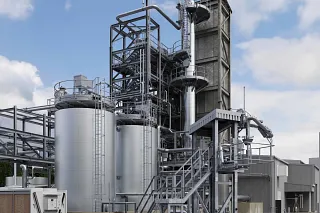
In the future, chemical recycling will shine where conventional recycling reaches its limits. To support Mura in the start-up phase and help the technology to a global breakthrough, igus invested £4 million (€4.7 million) in January 2020 and increased its investment to a total of €5 million in March 2021. Thanks to this support and the establishment and expansion of further partnerships, Mura was able to start constructing the first commercial HydroPRT plant. This is being set up at the Wilton International industrial site in Teesside in the north-east of England.
The video shows the process of oil recovery from HydroPRT
Since April 2021, Dow Chemical, the world's second-largest chemical company, has been another partner. The collaboration will further advance the scaling of Mura's cutting-edge recycling process. Dow will use the newly extracted raw materials to develop new plastics for food packaging and other packaging products that will eventually be recycled back into global supply chains.
The process is planned as follows: waste companies supply the plastic waste to achieve their recycling goals. Oil is then obtained at a price similar to that of fossil oil. In the first phase, a total of four catalytic hydrothermal reactors will be built in Teesside to process more than 80,000 tons of plastic waste every year. In addition, further plants are planned in Germany, the USA and Asia, among other places.
Video of the large construction site in England
Construction progress on the first plant
In April 2021, Mura Technology began construction of the first large-scale plant in England for recycling unsorted plastic waste. The first installation on site took place on 15th July 2022. The opening took place on 26th October 2023, where investors, partners, and supporters were able to see the plant for the first time. It will actually be commissioned in 2026.
Consulting
I look forward to answering your questions
Hennlich doo Beograd+381 11 63 098 17Write e-mail
Shipping and consultation
In person:
Monday to Friday from 7 am - 8 pm.
Saturdays from 8 am- 12 pm.
Online:
24h
WhatsApp-Service:
Montag – Freitag: 8 – 16 Uhr