Change Language :
What are the different types of linear drives?
At first glance, one might think that explaining a linear drive is a simple task. But that is not quite the case. While it is true that all linear drives are devices that convert energy into linear motion, there are several different types of linear drives that generate this motion in different ways. In this blog, we take a look at the four main types of linear drives and their subcategories, how they work and what the differences between them are.
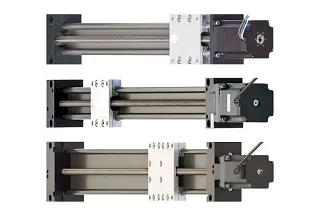
Electromechanical linear drives
Electromechanical linear drives are driven by an electric motor and convert the rotary movement into a linear movement. There are different types of electromechanical drives, including toothed belt, lead screw and rack and pinion drives.
These drives are often used in applications where accuracy and controlled movement are crucial, e.g., in robotics, medical devices and industrial automation. By using an electric motor to control a linear system, electric drives can provide smooth, adjustable positioning with minimal maintenance.
Some key benefits of electromechanical linear drives include their precision, ease of integration with digital control systems and their quiet operation. They also offer clean performance as they do not require hydraulic fluids or compressed air, reducing the risk of leaks and contamination.
Electromechanical drives have limited force capacity compared to hydraulic options, making them less suitable for heavy-duty applications. They can also involve higher initial investment and are sensitive to high temperatures, which can affect their service life and performance under extreme conditions.
Toothed-belt-driven linear drives
As the name suggests, toothed-belt-driven actuators use a tensioned toothed belt to control linear motion. They can be operated manually or connected to a stepper motor or DC motor for automated operation.
These drives are ideal for high-speed and low-load applications. Toothed-belt drives must be properly tensioned, whether manually or automatically. Fortunately, the video linked below shows how this can be done quickly and easily.
Linear robots - such as igus drylin linear robots - often use toothed-belt-driven drives instead of lead screw drives because they require high speeds and usually do not need to carry excessive loads. However, the optimal type of drive depends on the specific application. In certain cases, a combination of both types of drive may be the best solution.
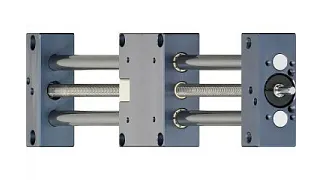
Linear drives with plain bearing lead screws
Like belt-driven linear axes, linear axes with lead screws are used to generate precise linear movements, but they use a lead screw instead of a toothed belt as the drive element. As with belt-driven linear axes, linear axes with lead screw can be operated manually or with a motor, depending on the requirements of the particular application. They are best suited for applications that require high accuracy in short travels.
Lead screws of linear axes can be guided by round shaft guides or profile rail guides, each of which offers different advantages. Profile rail guides are stiffer and more resistant to torsion than round shafts, but round shafts are often available in a wider range of materials. In round shaft guide systems, dirt and grime can also be removed from the guide more easily than in profile rail guides, making them better suited for applications with a lot of grime.
Linear drives with ball screws
Linear drives with ball screws are very similar to linear drives with plain bearing lead screws. The circulating balls between the lead screw and nut allow for less friction, higher efficiency and high load capacity. However, this comes with disadvantages such as increased noise levels, the risk of back-driving and a more frequent need for lubrication.
The high accuracy and robust design of linear drives with ball screws make them ideal for applications such as robotics, medical devices and CNC machines. However, their relatively high price often makes them a less ideal choice for simple or less demanding applications.
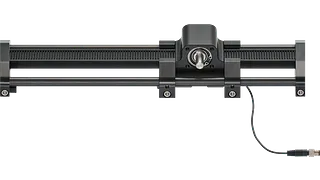
Linear drives with gear rack
Rack and pinion drives consist of a gear rack and a gear. When the gear rotates and engages with the gear rack, it moves the gear rack forwards or backwards, allowing for controlled linear movements.
Rack and pinion drives offer high robustness, high load capacity and are suitable for use in various ambient conditions, including applications with heavy loads. Rack and pinion drives are often combined with electric servo motors and are particularly suitable for long travels as well as applications with high forces and speeds.
Hydraulic linear drives
Hydraulic drives use a fundamentally different configuration than the mechanical ones previously discussed. They consist of a piston inside a cylinder, with an attached pump that supplies hydraulic fluid that moves the piston, creating motion.
Due to the very low compressibility of hydraulic fluids, high forces can be precisely transmitted and loads can be held in a closed hydraulic circuit. However, hydraulic drives can suffer from leaks that cause both a loss of pressure and cleanliness problems, making them more maintenance-intensive than pneumatic and mechanical drives.
Hydraulic drives are ideal for applications involving high forces, such as in heavy-duty industries like construction or agriculture, as they can generate many times more force than a pneumatic drive of the same size and can reach pressures of up to 420 bar.
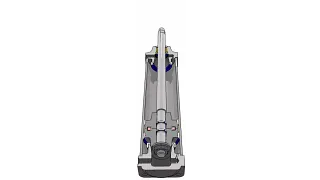
Pneumatic linear drives
Pneumatic drives work very similarly to hydraulic drives, with the key difference that they use compressed air instead of hydraulic fluid. They are much simpler in design than hydraulic drives and require a compressed air supply, which is typically provided by a compressor.
Thanks to their simple design, pneumatic drives are a cost-effective and lightweight option. They can also operate at extreme temperatures because compressed air is relatively safer than hydraulic fluid or electricity.
Pneumatic drives are frequently used in various automotive applications and are popular due to their lightweight feature, high dynamics and simple control system. Pneumatic drives are also widely used in other areas, such as packaging and material handling.

Piezoelectric linear drives
Piezoelectric drives (piezo drives) use electrical currents for movement, similar to electromechanical drives. In contrast, these drives use piezoelectric materials – either special ceramics or crystals – that expand when exposed to an electric field, thereby generating motion.
This unique design makes piezoelectric drives the solution for high-precision applications that require micrometre accuracy. They are often used in the semiconductor industry, laboratory applications and medical technology.
Piezoelectric drives can also be divided into three subcategories:
- Stick-slip piezoelectric drives: They use a sawtooth voltage profile to create a slow, high-friction "stick" phase followed by a fast, low-friction "slip" phase. This combination uses inertia to achieve movement in small steps.
- Stepping piezoelectric drives: They use several co-ordinated piezoelectric elements like "legs" that clamp, expand/bend and release a runner one after the other, achieving a long-stroke "walking movement" in discrete steps.
- Ultrasonic piezo drives: They operate at high frequencies (ultrasound) using resonance vibrations, which are converted into an elliptical motion at a friction contact point to drive a slide quickly and smoothly.
Each of these categories has its own specific strengths and weaknesses, but they share the general advantages of piezoelectric drives over other types of drives and can be used in similar applications.


